

 D-Music BAXX-EQ Mastering Equalizer Profiles for NAM (Updated)
$24.99
EQ
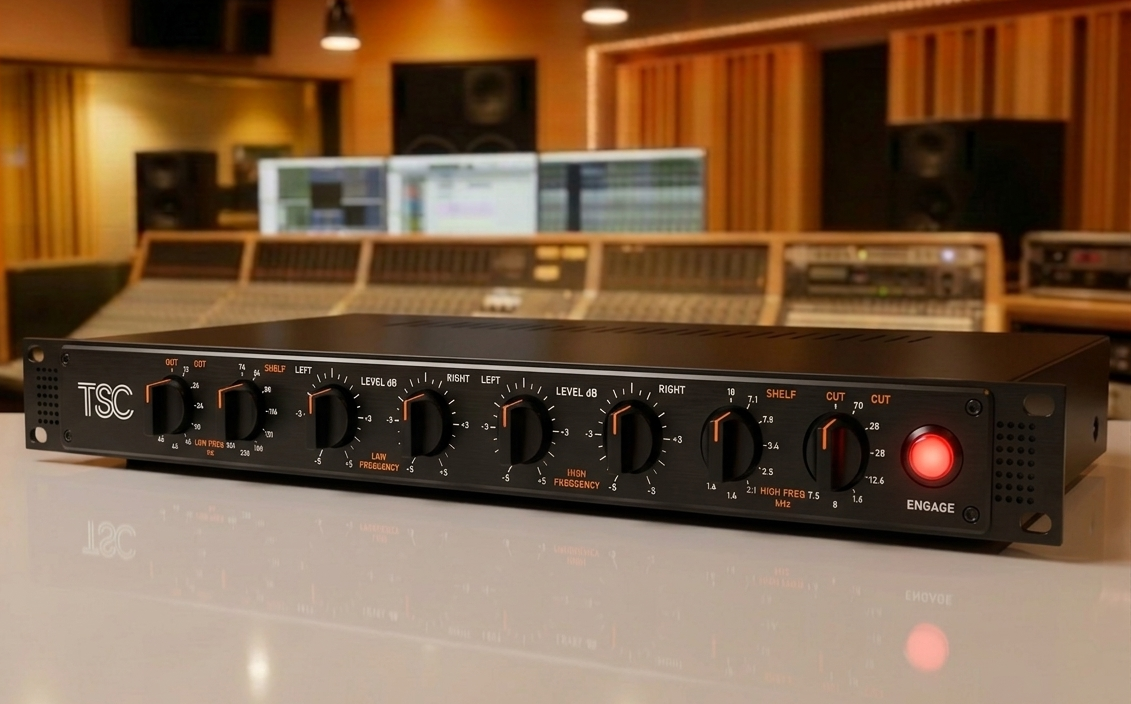
Wide, elegant curves for effortless low-end weight, open highs and natural tonal balance.
“This sounds absolutely beautiful on a master. Opens up the middle while keeping the lows punchy!”
$24.99
Broad curves. Musical shaping. Effortless polish.
The BAX EQ is not about surgical precision — it’s about wide, musical moves that simply feel right.
Its gentle curves allow you to shape the low and high end in a natural, unobtrusive way, adding depth, clarity, and balance without disrupting the mix.
Now updated with independently captured Left and Right channel profiles for authentic True Stereo operation using TSC Rack’s L/R Split mode.
TSC Ecosystem
Standard .nam files that work in any compatible NAM player. Load them into TSC Rack 2, combine them with other Captures, and use the chain directly in your DAW.
Compare the original hardware signal and the NAM profile across a range of sources — bass, guitar, synth, and more.
Each example demonstrates how closely the profile captures the tone, dynamics, and harmonic response of the hardware.
The NAM and hardware samples are gain-matched to allow for a more accurate evaluation of the capture’s fidelity.
For additional context, a dry (unprocessed) version is also included.
A collection of BAX-style mastering EQ profiles captured across carefully controlled settings.
Profiles included:
True Stereo Operation
The original hardware features independently operating channels, each with its own unique analog behavior and subtle sonic characteristics.
To preserve this authenticity, every profile pair was captured independently from each channel of the original hardware.
Unlike conventional stereo processing, the Left and Right channels are not duplicated. Each profile retains its own unique analog fingerprint, closely reflecting the behavior of the original unit.
For the intended experience, load the matching CH1 and CH2 profiles using TSC Rack’s L/R Split mode. This preserves the natural depth, width, and dimensionality of the original hardware.
Our captures are pre-calibrated at -18 dBFS input level.
For best results, we recommend feeding the plugin with an input signal close to -18 dBFS.
Due to gain reduction during the profiling process, the output level of a loaded profile may be slightly lower than the original input signal.
Please adjust the Output control to match your source level or to reach your preferred listening volume.
This product consists of digital NAM profiles captured from real hardware. All products are independently developed by TSC (Tokyo Studio Capture) and are not affiliated with, endorsed by, or officially connected to any hardware or software manufacturers. Any product names, references, or visual elements are used strictly for descriptive purposes only. All trademarks and brand names are the property of their respective owners.
Studio updates, behind-the-scenes content, new releases, and more.
@tokyostudiocapture →Exceptionally smooth, transparent EQ shaping for clarity, balance and mastering-grade polish.
$29.99 Add to cartSmooth optical control and polished tube EQ with depth, cohesion and an airy finish.
$29.99 Add to cartRich analog texture, grain and weight — adding a tactile, organic character that goes far beyond EQ.
$29.99 Add to cartD-Music BAXX-EQ Mastering Equalizer Profiles for NAM (Updated)
Devin B. (verified owner) –
This sounds absolutely beautiful on a master. Opens up the middle while keeping the lows punchy!
Alfonso (verified owner) –
Next to the hardware unit, you have the color with this profile, comparing favorably with more expensive software emulations and getting almost the harware quality for a fraction of the price.
Chris –
I’ve used the hardware for years, and this is the first profile that actually gets that ultra-wide, open top-end right. It’s so musical.